CASE STUDY / CONTENT OPERATIONS

A human-supervised content production system built for reliability, not just automation.

Content Engine and Media Render Engine coordinate a recurring workflow from source material through editorial review, visual production, human approval, publishing and measurement.

The system automates repeatable coordination around the work. Editorial, visual and publishing decisions remain explicit human decisions.
Review is separate from productionA review asset requires explicit human approval before it becomes a production asset.REVIEW ASSETHUMAN APPROVALPRODUCTION ASSET

A review asset requires explicit human approval before it becomes a production asset.

  1. REVIEW ASSET to HUMAN APPROVAL (human check)
  2. HUMAN APPROVAL (human check) to PRODUCTION ASSET (controlled state)
STATUS / LIVE OPERATING SYSTEM
OWNER / FB DIGITAL MEDIA
THE PROBLEM

The fragile part was not one task. It was the path between them.

Drafting content, producing media, approving an asset or publishing a post are individually manageable tasks.

The complexity appears between them.

One source can produce several content candidates. Editorial review determines what moves forward. Different platforms may require different execution. Visual production introduces another review decision. Publishing needs the correct approved combination of content and media. And the system still needs to understand what happened if a step succeeds only partially.

Without a clear operating structure, automation can make a fragmented workflow move faster without making it safer.

BRIEF to FILES_V7: copied handoffBRIEF passes to FILES_V7 through a fragmented handoff marked COPIED.BRIEFFILES_V7COPIED

BRIEF passes to FILES_V7 through a fragmented handoff marked COPIED.

  1. BRIEF to FILES_V7 (unresolved) — problem handoff: COPIED
EMAIL? to REVIEW: who? handoffEMAIL? passes to REVIEW through a fragmented handoff marked WHO?.EMAIL?REVIEWWHO?

EMAIL? passes to REVIEW through a fragmented handoff marked WHO?.

  1. EMAIL? to REVIEW (unresolved) — problem handoff: WHO?
STATUS to OWNER: waiting handoffSTATUS passes to OWNER through a fragmented handoff marked WAITING.STATUSOWNERWAITING

STATUS passes to OWNER through a fragmented handoff marked WAITING.

  1. STATUS to OWNER (unresolved) — problem handoff: WAITING
OBJECTIVE

Create one controlled path from source material to measured publication.

OPERATING MODEL

One visible state for the work.

The system was redesigned around a simple idea: the workflow should know what has happened, what is allowed to happen next and which decisions still belong to a person.

Work has an explicit state. Approvals are recorded as decisions rather than inferred from messages. Known work is not blindly repeated. Review and production remain separate environments. Failures can be identified and recovered. Publishing becomes part of the recorded workflow rather than a private checklist.

The result is not simply “more automation”. It is more control over how the work moves.

BEFORE / FRAGMENTED
BRIEF to FILES_V7: copied handoffBRIEF passes to FILES_V7 through a fragmented handoff marked COPIED.BRIEFFILES_V7COPIED

BRIEF passes to FILES_V7 through a fragmented handoff marked COPIED.

  1. BRIEF to FILES_V7 (unresolved) — problem handoff: COPIED
REDESIGN
DESIGNED / ONE VISIBLE STATE
Designed state: one visible pathSource moves through editorial review to an approved state, then production.SOURCEEDITORIAL REVIEWAPPROVEDPRODUCTION

Source moves through editorial review to an approved state, then production.

  1. SOURCE to EDITORIAL REVIEW (human check)
  2. EDITORIAL REVIEW (human check) to APPROVED (controlled state)
  3. APPROVED (controlled state) to PRODUCTION
WORKFLOW ARCHITECTURE

A controlled path through recurring content production.

Content Engine owns the content lifecycle: source records, candidate state, eligibility, review and publishing status.

Media Render Engine handles visual-production requests and returns the result to the requesting work.

Neither system is meant to make every judgement itself. The renderer does not decide whether a visual is good enough, and the publishing layer does not decide whether content deserves to be published.

That separation keeps responsibility clear.

Content Engine and Media Render Engine public workflowSource material moves through candidate content, two explicit human reviews, publishing and measurement.SOURCE MATERIALCANDIDATE CONTENTEDITORIAL REVIEWAPPROVALPLATFORM EXECUTIONVISUAL REVIEW /WHERE NEEDEDPUBLISHINGMEASUREMENT

Source material moves through candidate content, two explicit human reviews, publishing and measurement.

  1. SOURCE MATERIAL to CANDIDATE CONTENT
  2. CANDIDATE CONTENT to EDITORIAL REVIEW (human check)
  3. EDITORIAL REVIEW (human check) to APPROVAL (controlled state)
  4. APPROVAL (controlled state) to PLATFORM EXECUTION
  5. PLATFORM EXECUTION to VISUAL REVIEW / WHERE NEEDED (human check)
  6. VISUAL REVIEW / WHERE NEEDED (human check) to PUBLISHING
  7. PUBLISHING to MEASUREMENT
STATEHUMAN GATERENDER REQUESTPRODUCTION
HUMAN JUDGEMENT

Automation moves work. People still decide what is good enough.

Editorial approval remains human. Visual approval remains human. Platform suitability, exceptional holds and releases, strategic choices and decisions about what should be automated next also remain human.

The system can prepare the work, move information, update state, create production requests and make the next action visible.

It does not need to replace the judgement that gives the work its value.

What should stay human in an AI-assisted content workflow?

  1. SYSTEMPREPARES
  2. HUMANDECIDES
  3. SYSTEMCONTINUES
PRINCIPLE

The objective is not to remove judgement from creative work. It is to remove unnecessary coordination around that judgement.
APPROVAL BOUNDARY

A render can exist without being approved.

4:5SANDBOX / REVIEW
Sandbox preview of an editorial carousel slide, including the original renderer preview watermark
01 / Sandbox preview — available for human inspection, not for publication.
HUMAN
APPROVAL
4:5PRODUCTION / CLEAN
Clean production version of the same approved editorial carousel slide, without the Sandbox watermark
02 / Production render — clean asset prepared after approval.

Passing a render check does not mean the creative is approved.

The Sandbox version is available for human inspection. A rejected asset returns for revision instead of silently continuing because the render succeeded.

Only explicit visual approval permits the clean Production render to move forward. The decision remains visible in the operating workflow.

How to fix a content approval workflow spread across email and chat

WHY A TAILORED SYSTEM

Standard software is useful when the workflow fits the standard model.

If the process is simply create → approve → schedule → publish, an existing content platform may already solve the problem very well.

This workflow had additional requirements: source harvesting, editorial decisions, bilingual content candidates, platform-specific execution, separate media production, visual approval, review-versus-production boundaries, recovery after uncertain execution, publishing state and later measurement.

The objective was not to rebuild software that already existed.

The missing piece was an operating layer connecting parts of the process that were not sensibly modelled together.

Use existing software where it works, connect or extend it where useful, and build only what the workflow genuinely requires.

STANDARD CONTENT FLOW
  1. Create
  2. Approve
  3. Schedule
  4. Publish
THIS WORKFLOW
  1. Source
  2. Editorial
  3. Platform
  4. Media
  5. Visual approval
  6. Production
  7. Publish
  8. Measure
OPERATING EVIDENCE

A happy path is not enough.

The system became more useful after real operation exposed problems that were difficult to see in a clean prototype.

Duplicate execution showed that retrying a task is not always safe. External success combined with incomplete internal state showed that a system sometimes needs to reconcile what actually happened before acting again.

Review and production activity exposed the need for a stronger boundary between experimentation and live execution. Repeated status checking showed that some work was better triggered by events than by constant polling.

Those failures led directly to architectural changes.

  1. DUPLICATE EXECUTIONIdentity-aware retry
  2. PARTIAL STATEReconciliation
  3. REVIEW / PRODUCTION OVERLAPStronger environment boundary
  4. UNNECESSARY CHECKINGEvent-driven triggers
RELIABILITY

The system should behave predictably when something goes wrong.

IDENTITY / DUPLICATE PREVENTION

A rerun should not create a duplicate

Known work is identified before an uncertain task is repeated.
RECONCILIATION

Reality is checked before assuming what happened

If an external service may have succeeded while the internal record did not update correctly, the system reconciles the two before continuing.
STAGING / PRODUCTION BOUNDARY

Review output does not silently become production output

Testing and live execution remain separate.
CONTROLLED EXECUTION

Critical work does not collide unnecessarily

Some operations are deliberately sequenced when parallel execution would create risk.
SCOPED CALLBACK / OWNERSHIP

Results return to the right requesting work

A production result needs clear ownership rather than simply existing somewhere in the system.
OBSERVABILITY / RECOVERY

Failures can be seen and recovered

A failed step should leave enough state to understand what happened and decide what to do next.
TRIGGER DESIGN

Automation does not need to keep asking the same question.

CHECK → NOTHING / REPEATED
Before: repeated checkingA schedule repeatedly checks for work, whether or not a real event occurred.SHORT INTERVALCHECK AGAINPOSSIBLE WORKREPEATSMAYBE

A schedule repeatedly checks for work, whether or not a real event occurred.

  1. SHORT INTERVAL to CHECK AGAIN (unresolved) — problem handoff: REPEATS
  2. CHECK AGAIN (unresolved) to POSSIBLE WORK (unresolved) — problem handoff: MAYBE
REDESIGN
EVENT → WORK
Designed: activity follows a real triggerReal events, deliberate schedules and operator actions trigger appropriate work.REAL TRIGGERRIGHT CONTROLELIGIBLE WORK

Real events, deliberate schedules and operator actions trigger appropriate work.

  1. REAL TRIGGER to RIGHT CONTROL (decision)
  2. RIGHT CONTROL (decision) to ELIGIBLE WORK (controlled state)

Early versions of a workflow often rely on scheduled checks: “Is there anything to do yet?”

That can be useful initially, but it creates unnecessary activity when nothing has changed.

Where appropriate, the system now favours events, operator actions or defined production windows that indicate when real work exists.

Trigger because something happened, not because the system checked again.
OPERATING SNAPSHOT / REAL SYSTEM

Real work, recorded decisions and a visible publishing queue.

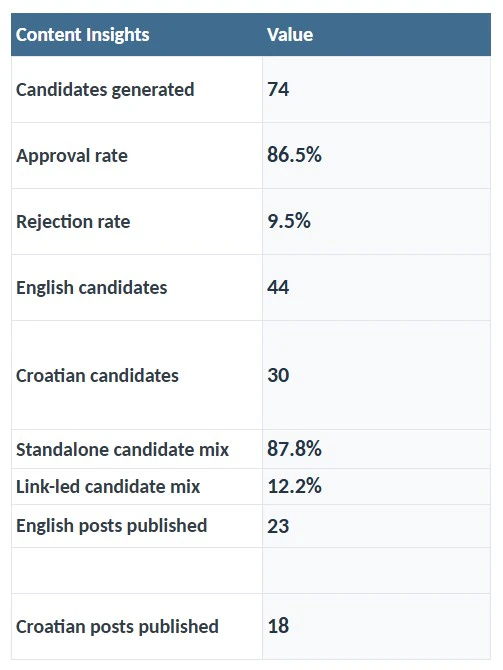
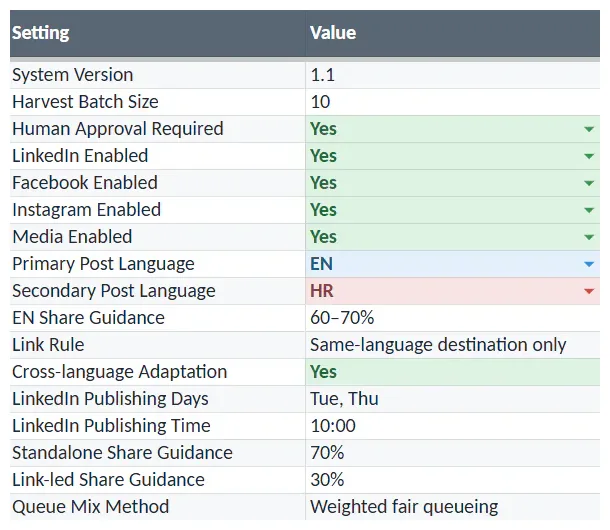
The live Content Engine dashboard records candidate activity, editorial decisions and published output. These figures come from a captured dashboard view, not a projected saving or a claim of ROI.

Content Insights was captured on 10 October 2026. The settings and publishing queue screenshots document separate operating views; they are not presented as simultaneous measurements.
CAPTURED / 10 OCTOBER 2026
  • 74CONTENT CANDIDATES
  • 86.5%CANDIDATE APPROVAL RATE
  • 41PUBLISHED POSTS
  • 23 / 18ENGLISH / CROATIAN POSTS
Content Insights dashboard showing 74 generated candidates, an 86.5 percent approval rate, and 23 English plus 18 Croatian published posts
CONTENT INSIGHTS / 10 OCT 2026Candidate activity, review outcomes and publication by language.
Content Engine setting and value columns showing human approval required, LinkedIn Facebook and Instagram enabled, media enabled, English and Croatian languages, and publishing controls
OPERATIONAL CONTROLS / SETTINGSHuman approval, platforms, language guidance and operating choices are explicitly configured.
Separate Content Engine publishing queue screenshot, showing scheduled execution state and language
PUBLISHING QUEUE / SEPARATE CAPTUREThe work remains visible after editorial approval, through scheduling and publication.
WHAT THIS PROVES

The transferable part is not the Content Engine itself.

Content Engine and Media Render Engine are not client templates that FBDM Systems copies into another business.

The transferable value is the way the workflow was designed and improved: explicit state and ownership; clear human decision points; connected stages without losing responsibility; duplicate prevention; failure recovery; review-versus-production separation; auditability; and architecture changed by operating evidence.

Another team may use completely different tools, approvals, content types and integrations.

How should the work actually operate?

YOUR WORKFLOW WILL BE DIFFERENT

You do not need Content Engine.

You need the right operating design for your own recurring work.

The Workflow Systems Blueprint looks at how the process works today, where coordination becomes difficult, which decisions should remain human, what existing tools can continue to do and whether anything should be connected, automated or built.

NO ASSUMPTION THAT A BESPOKE BUILD IS REQUIRED.